Showing posts with label travel tales. Show all posts

Bhutan: The last leg of our journey at Paro and a round up

Did you read the last post about how we made it to the top of the Takstang Monastery? If not, please do go back and read it.

Before I continue, here's a check-list that will come in handy for travelers.

Things to keep in mind while visiting the Taktsang or the Tiger's Nest Monastery 

1. You are supposed to be fully clothed while visiting this one or any other monastery/temple or Dzong in Bhutan. Which means you cannot wear short skirts, shorts, capris or the likes. Even your hands must be covered, so choose a full or three-fourth sleeved suit, top or shirt. Alternatively, you can wear a jacket or shrug.

2. Use of photography/video is prohibited in the inner sanctum of all temples and monasteries. At the Tiger's Nest, you have to surrender your backpacks with mobiles outside with the security. There are no lockers but like I said earlier, it's absolutely safe even without the lockers.

3. Wear a good quality and comfortable pair of sports shoes if you're trekking to the Tiger's Nest Monastery. Trust me, the quality of the shoes makes a big difference. Seasoned trekkers and runners can vouch for this bit of nugget.

4. Carry water bottles and some dry snacks in your bag pack (and an umbrella if you are visiting during the rainy season). Make sure the pack isn't too heavy at the same time. Our guide was sweet enough to carry two extra bottles for us in his pack since we were carrying just one bag pack for the six of us.

5. The rise in the altitude can cause some people to become breathless, dizzy or feel uneasy. The symptoms could range from having a dull ache in the head to severe nausea. So, if you feel at unease at any point during the climb, please let everyone in your group know and stop till you feel better or if you're feeling worse, abandon the trek. Thankfully, none of us including the kids had any trouble.
****
It took a good one hour to visit each of the smaller shrines inside the Tiger's Monastery and by the time we came out we were famished. The thought of starting on the arduous route yet again made me want to just stay back! Well, that wasn't possible and also we had to make it back to the cafeteria at a decent hour for lunch. That was incentive enough for us to dismiss our inertia and start our descent. Our stock of biscuits and some fruit came in handy.

We huffed and puffed our way down, wondering if we really climbed all this way up. The path did seem to stretch on endlessly. The only way to minimize the strain, I realized, was to converse energy by talking or complaining less and just keep walking. As the cafeteria came into sight, we did not feel any less than conquerors. After filling our tummies with some yummy food, we completed the last leg of the trek to reach the base with renewed vigour.

Even as I felt a sense of pride and accomplishment, I worried about the body getting stiff and dealing with aching joints. However, I was pleasantly surprised to note that other than being exhausted from a rigorous day, there was no major ache. In fact, all of us were fresh and raring to go the next day with no signs of fatigue. 
****
It was the final day of our trip. We proceeded to visit the highest motorable pass, the Chele La pass from where one can view the Haa valley on one side and the Jhomolhari peaks on the other. We caught a tiny glittering part of the snow clad peak for a few seconds. For the most part, it was as though we were engulfed by thick, moving clouds. It can get extremely windy here, so make sure you carry your mufflers, sweaters, jackets. Also, take note that there are no toilets here. A cold and windy place compounds the inconvenience? Of course! Ah, well, that's something one has to contend with here. 


If the Punakha Dzong was magnificent and huge, the Paro Dzong was no less beautiful if only much smaller. 


That's a view from outside the National Museum of Bhutan. Doesn't it seem like the heavens are showering their blessings?

The original building that housed the museum got damaged by a fire and was under restoration. The exhibits were shifted to a temporary building which we visited.

Not a large museum, it was still interesting with sections that housed information about the climatic change and its impact on humans, the flora, and fauna. Exhibits of animal masks, each animal representing a human trait or nature. Sections that spoke about the history and culture of Bhutan.


Well, didn't I say we had hatched plans to get pictures clicked in the national dress of Bhutan? There was a quaint little store in the midst of this idyllic view (well, isn't the entire country idyllic?) that gave out these outfits on rent.

We left for Phuentsholing the next morning. As it happens with a great vacation coming to an end, I was fraught with mixed feelings. I felt blessed to be able to create and take back some lovely memories.

Although small in size and economy, there's a lot the entire world can learn from the kings/leaders of Bhutan and the way the Bhutanese conduct life. May this country ever remain as pure and pristine in its beauty, thoughts and action!

_______

I recently viewed a TED talk on how Bhutan stands in the wake of climatic change. It's something I've been mulling over too. Will try to share my views and the video in a post, soon!

Hope you all enjoyed Bhutan through my eyes.

Bhutan: River-rafting at Punakha and an unforgettable trek at Paro

From here on, we begin the last leg of our journey in this mythical, mystical and beautiful country of Bhutan. And, like the icing on the cake, the last few days of the trip built up to a befitting crescendo.

As we bade goodbye to Punakha, we rounded it up with an exhilarating white river rafting ride on the Mo Chhu river. This was not on our itinerary initially but one we could, fortunately, fit into our schedules and oh boy, did we enjoy it!

Our group could be best called as rookies in the field of adventure sports and were suitably excited and anxious about what to expect. We assembled at the starting point of the one-hour rafting ride on the Mo Chhu waters, slated to end at the Punakha Dzong where the Mo Chhu and Po Chhu merged as one.

Our rafting guide, Karma, was a cheerful and lively fellow who kept us (and the kids) entertained through the entire ride with his perky commentary and instructions. At the outset, we were given our life jackets, head gear, and the oars with specific instructions on how to hold the oars and the precise rowing movement to follow upon the said command from him. We were to basically aid him, the lead navigator, to traverse along the rapids. This was going to be a basic level rafting with zero-risk and we made sure that our frisky kids were eligible for the ride.

All set for the ride: happy and excited!
We had never imagined the kind of fun that ensued. Every rapid we encountered had us in raptures and soaked to the skin, the sudden uptilt of the raft as it glided over the waves brought out peals of nervous laughter. Our guide kept the atmosphere light and lively with his pep talk, encouragement and anecdotes.

Our driver, Tending met us at the point where our river rafting ride ended and we left Punakha for Paro, our minds and body still tingling with the thrilling experience. We once again stopped by at Dochula pass, but this time it was for lunch. Paro was about a 3-hour drive thence.

Can you guess this location from the image below?


It's the airport at Paro. Wedged between mountains and a river, isn't it such a beauty?

Now, imagine being able to catch this view from thousands of feet above on a flight and watch this spectacular sight zoom in slowly as you gently glide down and touch the runway.

While we weren't lucky enough to experience a flight journey thus, we were certainly lucky to catch an airplane take off and then again a couple of days later, on our return journey, another making its descent. Considering the rather low frequency of flights in and out of Bhutan, these were rare sights, indeed.

On a side note, how convenient it must be to simply walk into the terminal from one end and then hop onto the aircraft from the other end just like that!


As the sun began to sink behind the mighty Himalayan peaks, we reached the resort at our final destination, Paro. We were advised to rest well for a long and tedious trek next day to the Tiger's Nest Monastery or the Taktsang monastery.

This monastery is rather significant in the mythology of Bhutan as it is believed that Guru Rinpoche flew, seated on a Tigress, atop the cliff of this mountain to quell certain evil forces and it was then he discovered a tiger's cave or nest. The tigress on whose back he flew was none another than one of his consorts who transformed herself into one to aid the Guru in vanquishing the demonic forces.

We booked a guide from our hotel for this trip since the monument was a treasure trove of stories and mythological beliefs of the Buddhists and we were eager to hear them all.


Can you see how high up there we had to climb and how steep that is? That's a total of 10 km (the ascent and descent put together). And, none of us had even done a 10 km marathon on a level ground before! That we were skeptical and apprehensive was putting it down mildly. The only thing we knew was that we didn't want to give this a miss at any cost.

We learned that there are ponies available for the ascent up to a certain point (for a distance of 2km until the cafeteria) post which one had to eventually go by foot. We decided to use the option. And, it proved to be a very wise decision. The journey is certainly long and tedious, so if you are a rookie trekker, don't be embarrassed or shy to do the same (even if you see people older than you climb all the way). Remember, you have to also walk all the way down.

But, what did I know? It's not a cake walk to ride a pony on the steep slopes. One, you feel bad for the poor creatures. Two (and, here I only speak for myself), the horses are definitely sure-footed but as they totter on the rocky edges from where you can see the deep valley right below your feet, you can only hold on to dear life and wonder if it would have been a wiser decision to trudge on foot.

Yet, now that I came back alive I can say that pony backs will save you the precious energy you need to conserve for the rest of the trek.


So near, yet so far. After this point, there were treacherous stony steps that wound down and then upwards in a zig-zag manner right up to the end point.

 Just a tiny glimpse of the path we traversed.


At a landing that provided a bird's eye view, perfect for taking proud selfies. It was surely a proud moment as we made it to the monastery.

There are about 5-6 temples clustered together within the main monastery. Each of these depicts the Guru in various emotions, each of them carrying a significance and a little story. The tiredness of the trek dissipates slowly even as peace and awe envelopes you in a spiritual embrace.

______

Did we collapse in exhaustion after the trek? What you need to know before you embark on this trek? 

All this in my next post. Do come back!

Bhutan: The picturesque landscape of Punakha valley

Punakha would be the most scenic places we visited in Bhutan. We left Thimpu after breakfast for this valley which was about a 3-hour drive. Our itinerary suggested we leave before dawn to catch the sunrise at a breakfast point on the way. However, since it had rained the previous evening, it seemed futile to clamber out of beds and the cozy hotel with kids in tow just to see the thick clouds descending over the far away mountains.

The roads all over are well-laid and except for the drive from Phuentsholing to Thimpu, the travel time for the rest of the tour did not span more than four hours. The drive around the winding, hilly lanes of Bhutan is sheer poetry. All along the way, you'd be accompanied by mountains in varying shades of green. The vegetation covering them is so dense that you can't see an inch of the Browns. These are punctuated by deep valleys every now and then. The crystal clear fresh rivers flowing through the passes are a refreshing sight and you never tire of taking in these chaste sights.

We stopped by at Dochula pass, a peak at an elevation of about 3000 meters or roughly 10,000 ft above sea level. On a clear day, one can view the snow-capped peaks of the Himalayan range from this point. This was where we were supposed to halt to view the sunrise. And, we knew our decision was not in vain because even at 10 am, we couldn't view past a 50-meter radius because of the thick mist all around. The constant chilly breeze lead us to bury ourselves deeper into our jackets.

Here's a snapshot of the heights of the peaks that can be viewed from here.
That's a lovely little cafeteria at the pass where you can stop for breakfast/lunch or snacks.
These are the Druk Wangyal Khang Zhang 108 stupas or war memorials also known as Chortens of victory.
Now you see them, now you don't.
The pic below is of the Druk Wangyal Lhakhang or monastery that was built to commemorate 100 years of monarchy in Bhutan. As we embarked to climb these steps, we were stopped by the guard up here who forbade us to venture any further. Taken aback, we turned to find another guard at the landing where we stood and asked why we were being stopped. He mentioned that the Queen (the wife of the fourth king) was visiting the monastery presently and we needed to wait until she left.
Wow, the Queen! We asked if we could wait and see her. To our surprise, he nodded his head in affirmation and asked us to step aside. His only request was that we shouldn't click any pictures of Her Highness. Of course, we were only too ready to comply. After about 15 minutes of waiting in childish anticipation, we saw her descending the steps with just a couple of guards and a Lama who accompanied her. We waved out to her and bowed with a namaste which she graciously responded to and also wished us a pleasant stay.

Buoyed by this unexpected pleasant turn of events, we continued our journey onwards.

At Punakha

The Punakha Dzong was a bewitching sight that held us in awestruck wonder. The Dzong is one of the oldest and the most beautiful ones in Bhutan, we were told. The latter part is easy to believe. Situated on the banks of a river, this gorgeous Dzong or fortress stands against the backdrop of the lush green peaks. A line of Jacaranda trees in full bloom dots the boundaries of the Dzong.

The Dzong is also considered important in the history of Bhutan. It used to be the seat of administration when Punakha was the capital of Bhutan. The recent king was coronated at this fortress.


The Mo Chhu and Po Chhu rivers that up until this point flow as separate rivers from Tibet converge here and here on flow as one river down the Punakha-Wangdue valley. Mo means mother and Po means father. Chhu means river, hence the names. True to their names, the flow of the Mo Chhu is far gentler and less dangerous than the Po Chhu making it suitable for water adventure sports like white river rafting.


We found a guide inside the Dzong who gave a brief about the history and significance of the place. There's a Buddha temple (the picture below) within the Dzong (as is the architectural norm of Dzongs) where the entire life history of the Buddha is depicted through paintings.


Our next stop was at Chimi Lhakhang. Literally translated to No-dog, this monastery was built by a Lama, Drukpa Kuenly who was known to practice Buddhist teachings in an unorthodox manner. He was also known as the Divine Madman. The temple is known to bless people who are battling infertility, hence it is popularly known as the fertility temple.

It was a refreshing one-hour walk (up-down) through green mustard and paddy fields to this temple.


It had been a fairly hectic day thus far. We had spent a great deal of climbing and walking around the Dzong and later at the Chimi Lhakhang. We were famished after we were back from the fertility temple and devoured the freshly-cooked food at a homely guesthouse we stopped by.

The weather just doesn't allow you to feel lethargic for too long. Our energy levels were restored with the short lunch break which was well past the usual lunch hour.

Just before we checked into our hotel that evening, we visited this huge suspension bridge and walked along the stretch. It was an amazing experience to walk on this iron swing bridge with the river gushing below us and the vast cloudy skies above. The gusty winds lent a thrill to the entire experience and we giggled like school kids as we strolled over to the other side.


We met a group of monks (below) at the other end.


We checked into our hotel that evening, our hearts filled with an explicable sense of satisfaction and happiness.

_____

Next stop is Paro and the travelogue is soon coming to an end. I've been trying to jot down most of the events as they occurred. Hope you enjoyed reading this.


Bhutan: A peek into the Bhutanese life, cuisine and hospitality

A travelogue is never complete without a reference to the food, customs and the lifestyle of the native dwellers. A country stands out from the rest because of its people, their habits, and food peculiar only to them.

The husband and I are not extremely adventurous in the food territory but we certainly like to have a taste of the local flavour wherever we go. The husband being a foodie helps the cause, of course. At the first opportunity, we placed an order for a 'datshi' which is a gravy based dish that the Bhutanese eat with rice

The national dish is called 'Ema Datshi' and is basically green chillies in a cheese-based gravy. Kewa Datshi is similar where the chillies are replaced with potatoes. We tried Ema Datshi at our Hotel in Phuentsholing. Sadly, we could not relish it. I did not like the cheesy taste and the chillies were too hot to enjoy. We later tried the Kewa Datshi at Paro and did find it good.

Picture Courtesy: By Bhutanese_hemadatsi_and_rice.JPG: ShashiBellamkondaderivative work: Thejinan (talk) - Bhutanese_hemadatsi_and_rice.JPG, CC BY 2.0, https://commons.wikimedia.org/w/index.php?curid=12628250

In my observation, the Bhutanese use a lot of cheese and butter (perhaps due to the abundance of cow's and yak's milk?) in their cuisine which by the way isn't too varied (at least for the vegetarians). There's Suja, a tea variant that's mostly butter, tea leaves, salt and a little milk. They say that such a combination is suited for higher altitudes. Hmm. We weren't gutsy enough to try it out.

Bhutanese mostly eat red rice. This, we tried at the cafeteria on the way to Tiger's Nest Monastery at Paro. Contrary to our misgivings about red rice being heavy to digest, we loved it. It was served with our usual yellow dal and it made for a perfect combination.

Bhutanese are sweet people but seems like they aren't sweet loving people. Apart from not having a native specialty, the menu cards often had just a fruit cocktail or a single flavoured ice-cream (even that was never readily available) listed under the dessert section. It can be disappointing for sweet lovers like us because we craved for desserts after our meals and found that the hotels do not stock up even on ice-creams. Even the rare ones that were offered as a part of a buffet meal are Indian sweets like rasgulla and gulab jamun, only perhaps to conform to international standard practices.

We hear that the Bhutanese, instead, are habituated to consuming betel leaves after meals. Something we observed from their red-stained teeth. The small stores along the road also sold packets of Paan that are eaten with betel nuts, and pieces of dried coconut.

The service at Hotels, in general, is pretty slow. If you're habituated to the brisk manner you're served food at Indian restaurants or elsewhere, be prepared to pull all your reserves of patience and breathe in the fresh Bhutan air while you wait. Because you'll have to wait a lot. Especially, if you prefer the Ala-carte over the buffet.

It seemed to us that they are not used to catering to a full house and aren't staffed appropriately. Each order is taken as a separate request and is prepared from scratch after the order is placed. For the record, although the buffet spread does not have a lot of variety,  the food here is quite tasty. Also, Indian food is easily available everywhere.

Tip: If there's a buffet spread, do not go for an Ala-carte, especially if you're hard pressed for time.

The Bhutanese are mostly simple, contented and soft-spoken people. Their faces radiate a sense of tranquility. As though reflecting off the benevolent Buddha who casts his abundant grace. In our limited interaction with the locals, we felt that they are a happy lot even as the younger crowd showed a keenness to visit and explore other countries.

A fun fact: The younger lot loves the Bollywood and the Hindi film music. In fact, our driver spoke good Hindi and he said he learned it all through Hindi movies. Interestingly, Bollywood films are not screened on the big screens and the youngsters rely on DVDs and the television to catch them all.

Bhutan is a clean country. Most tourist spots had toilet facilities and they were quite clean. Speaking of toilets, the hotels (barring the one at Thimpu) did not have the health faucet. If you're particular about such things, be mentally prepared.

Bhutan holds the reputation of being one of the safest countries in the world. In a place where the Gross National Happiness is considered and embodied in the constitution as the index of progress, this had to be a natural outcome, with the citizens having a high respect for the governing authorities, the laws and a reverential attitude towards their kings.

Bhutan is not yet enmeshed in the manic fad of development (a lot of which is a conscious decision on the part of the authorities) that recklessly throws away what is unique and relevant for a country and its people in pursuit of the contraptions of a more commercially developed economy. It could be seen as naive and short-sighted by some. However, in my opinion, it makes far more sense to design a roadmap that is sustainable and also relevant to the country's cultural and environmental values which may or may not be alike other economies.

________

Are you still with me on this journey? The more exciting parts are yet to come. So, do join me.

Bhutan: Around Thimpu, the serene capital city of Bhutan

After a tiring journey, we were glad to check into this beautiful heritage hotel. The beautiful aesthetics, typical of the Bhutanese paintings and artwork reminded me of the ones in Bali. We fell in love with our rooms: a mini-living area with low seating sofas, cushions and curtains all carrying the country's trademark patterns and colours. The adjoining bedroom was warm, inviting and spacious too. We joked that a hotel room of this size could well be someone's house in Mumbai's suburbs.


Early next morning we left to see the sights around the city but not before we stopped at yet another immigration office to get our permits done for Punakha. However, this was nothing compared to the elaborate one at Phuentsholing. Our driver got it done for us while we clicked pics of the adjoining beautiful lanes. 

The warm sun reflected off the bright blue skies that peeked out in turns from behind the spongy curtain of clouds that hung over the green, densely vegetated mountains.


The immigration office


That's the traditional dress worn by the Bhutanese. All of them, old and young, men and women, little boys and girls, school going children and working adults wear only their traditional clothing. For the women, it's something like a wrap around skirt with a formal blouse, called Kira. For the men, it's like a long colorful bathrobe folded under the waist to resemble a dress, called Gho, that falls just a little below the knees. The rest of the legs is covered with long stockings and shoes. Personally, I thought the Kira looked far better and smarter to wear than the Gho

Clicked outside our Hotel with a couple of high-school-goers

The sister and I immediately made plans to get our snaps clicked in those outfits. The husbands, not surprisingly, weren't too excited at the prospect but they did not have much choice in this matter!

Things to see and do in Thimpu

Thimpu is not a large city geographically and for a capital city, one might expect it to bustle with energy and activities. However, there's just a general calm prevailing amongst the people and life's rather slow and predictable. In fact, we found Phuentsholing far more brisk and prompt in pace and attitude.

1.The Thimpu Chorten

Built in the memory of the third king, this place is a revered and sacred place for the Buddhists. You can see several people circumambulating the structure and chanting outside the Chorten with the prayer wheel. The chant goes, "Om Mani Padme Hoon". It's a standard and universal mantra here that's found written over many structures, over colourful cloth buntings that flutter at strategic locations across the city and country.


Huge prayer wheels that you rotate with your hands as you go around
 

An old lady with the prayer wheel made for a serene picture composition

Designated areas to prostrate. They have a typical way of bowing down, quite similar to our Sashtang namaskars

Policemen smartly dressed outside the Chorten

2. The Buddha Dordenma Statue

This 51 meters tall giant Buddha statue made of bronze sits overlooking the city of Thimpu and lends a calming atmosphere as soon as one steps in here. The statue sits above a two-storeyed elevated structure, one of which is a prayer hall dedicated to the Buddha. 

The prayer hall on the first floor has the Buddha seated in the middle with standing figurines encircling the Buddha. (Photography within temples and Dzongs is prohibited)

The legend has it that Guru Padmasambhava or Guru Rinpoche as he is popularly known prophesied in the 8th century that a large statue of Buddha would be built in the twentieth century that would bestow peace and happiness to people all over. Guru Rinpoche is considered as the second Buddha by Buddhists as he was instrumental in reaching the Buddha's teachings to the common people. 

Temples all over Bhutan worship the trio of the Guru, the Buddha himself, and the Lama Zhabdrung who unified all the kingdoms under one peaceful nation. This also forms the core of the mythology and folklore of Bhutan's culture and traditions.


One of the golden Dakinis or celestial beings that surround the temple as though guarding it

View of the building across the Buddha Dordenma

A panoramic view of the surrounding structure and area from the Budda statue elevation.

3. Mothithang Takin Preserve

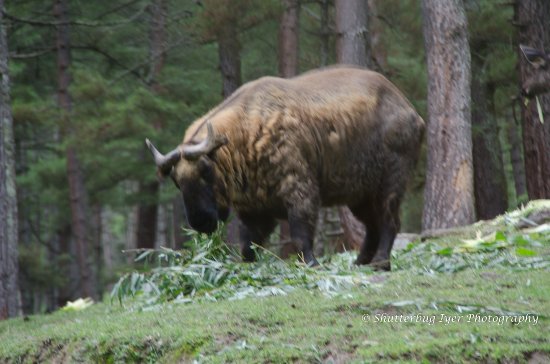
Takin is the national animal of Bhutan. It looks like a hybrid of a goat and a cow. We went to visit this unique creature at the reserve. The Preservatory is a small zoo where these rare species are housed. You need to walk around a bit to spot these animals in their natural habitat but unfortunately, a steady downpour caught us off guard. Although we went armed with umbrellas and jackets, they were all within the safety of our vehicle. So, we decided to make do with the first view of the creature from a rather long distance and hastened back.


This photo of Motithang Takin Preserve is courtesy of TripAdvisor 


4. National Folk and Heritage Museum

This museum is an insight to how the ancestors lived in Bhutan. One can see the iron cast vessels to the various tools used for hunting and cooking, the horse saddles, the food used for traditional cooking. The museum itself is housed in an ancient house with 2-3 storeys. Narrow, wooden steps lead you to each floor and then to the attic. 

A couple of cloth weavers sat outside the house spinning lovely designs on silk and cotton yarn to weave colorful stoles and jackets. (the cost of these can be anywhere between INR 1200- INR 6000 depending on the fabric and intricacy of the weave)

We do not have any snaps of these weavers from the museum but clicked a few at the in-house store of our Hotel.


A few points to know:

1. The Indian currency is largely accepted across Bhutan except for the new 2000 rupee notes and in some places the new 500 rupee notes.
2. Cards are accepted at prominent Hotels but for the smaller stores, it's advisable to carry change in Bhutan currency (ngultrum which is equivalent in value to INR). We got some cash exchanged at our Hotel in Phuentsholing itself.
3. We observed a lot of working women around Bhutan at the Hotels we stayed or around the city in general (as you can also observe from the weaving pics above), and we found that Bhutan is a matriarchal society with about 60% of businesses run by women. 
4. If you're interested in viewing the cultural dance, you can inform your travel agent or the Hotel you're staying at well in advance since that needs to be specially arranged for (during the non-festival period).
5. Most travel operators offer just a day's sight seeing in Thimpu and we thought it was sufficient. But, if you're looking for more sights, we hear that one can visit the National Library and a couple of Dzongs. 
6. At the Dordenma, we realized the need for a local guide who can explain the history and background in detail. However, as we inquired with our driver, we understood that usually tourists come armed beforehand with guides arranged by their tour operator and a separate guide at selected sights is hard to find. Having said that, as we progressed on our trip, we found a guide at the Punakha Dzong and one again for Tiger's Nest, Paro. So, the right approach will be to ask your tour operator first and then at the Hotels you are put up at. It is also not required to have a guide at all locations. 

We stayed only for a day in Thimpu. We stopped by at the local handicraft market before retiring to the Hotel for the day. The handmade curios are no doubt attractive but unless you're really keen the price is a deterrent to casual shopping lovers. Even a small metal keychain starts at around INR 250, so it's not really a shopper's paradise.

Our next stop is Punakha. Stay tuned!
________

Have you been to Thimpu? Do share your views and thoughts.